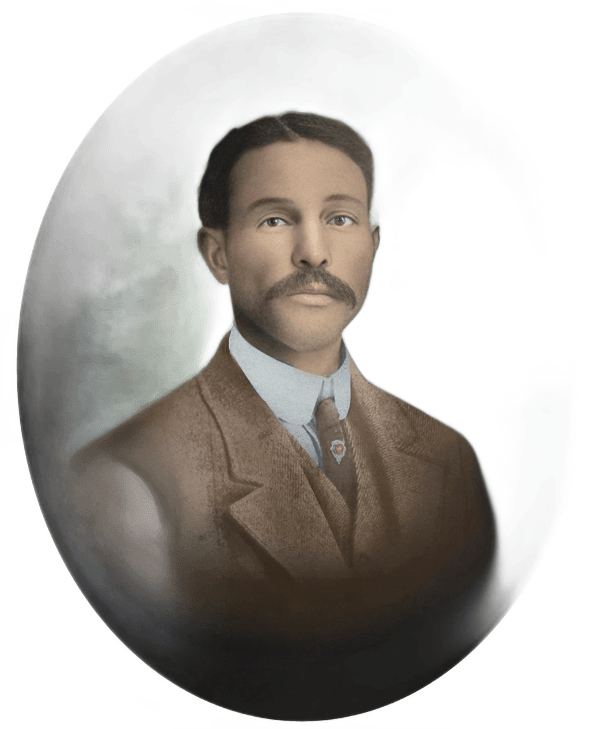
Dr. Andrew C. Jackson · February 8, 1879 – June 1, 1921
“The most able Negro surgeon in America.”
A Black surgeon whose skill was acknowledged by the founders of the Mayo Clinic. Murdered on his own lawn during the Tulsa Race Massacre after surrendering with his hands in the air. The A. C. Jackson Foundation exists to continue the medical, educational, and community work left unfinished by his senseless and untimely death on June 1, 1921.
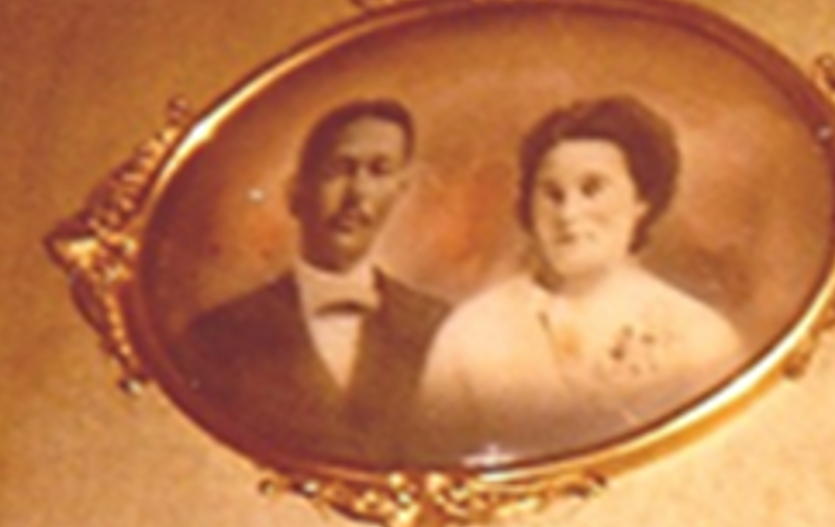
Dr. Andrew C. Jackson and his wife, oval studio portrait
Family photograph · private collection

Dr. Andrew C. Jackson (1879–1921), colorized oval studio portrait
Wikimedia Commons · public domain

Dr. Andrew C. Jackson, M.D., formal portrait, the original photograph from which later colorizations derive
Wikimedia Commons · public domain

Dr. Andrew Chesteen Jackson on his World War I draft card, already practicing as a physician in Tulsa
U.S. WWI Draft Registration Card · Wikimedia Commons · public domain
“Dr. A. C. Jackson was a Black doctor recognized as one of the country's leading surgeons. A white landowner reported going to Greenwood to check on his property and seeing 70-year-old Dr. Jackson walk out of his home with his hands in the air, surrendering to armed white men. The landowner asked these men not to hurt Dr. Jackson, but a young white man wearing a white shirt and cap nonetheless shot Dr. Jackson, who later died from his wounds.”
U.S. Department of Justice, Civil Rights Division, Review and Evaluation: Tulsa Race Massacre (Jan. 2025), ¶¶ 274–276
His life
From Memphis to Greenwood
Andrew Chesteen Jackson was born on February 8, 1879, in Memphis, Tennessee. His father, Townsend Dempsey (“T.D.”) Jackson, worked as a barber and later served as a lawman, a deputy sheriff and jailer in Tulsa. T.D. raised his son in a household that prized public service, literacy, and respectability politics at a time when those virtues offered Black families fragile, conditional protection.
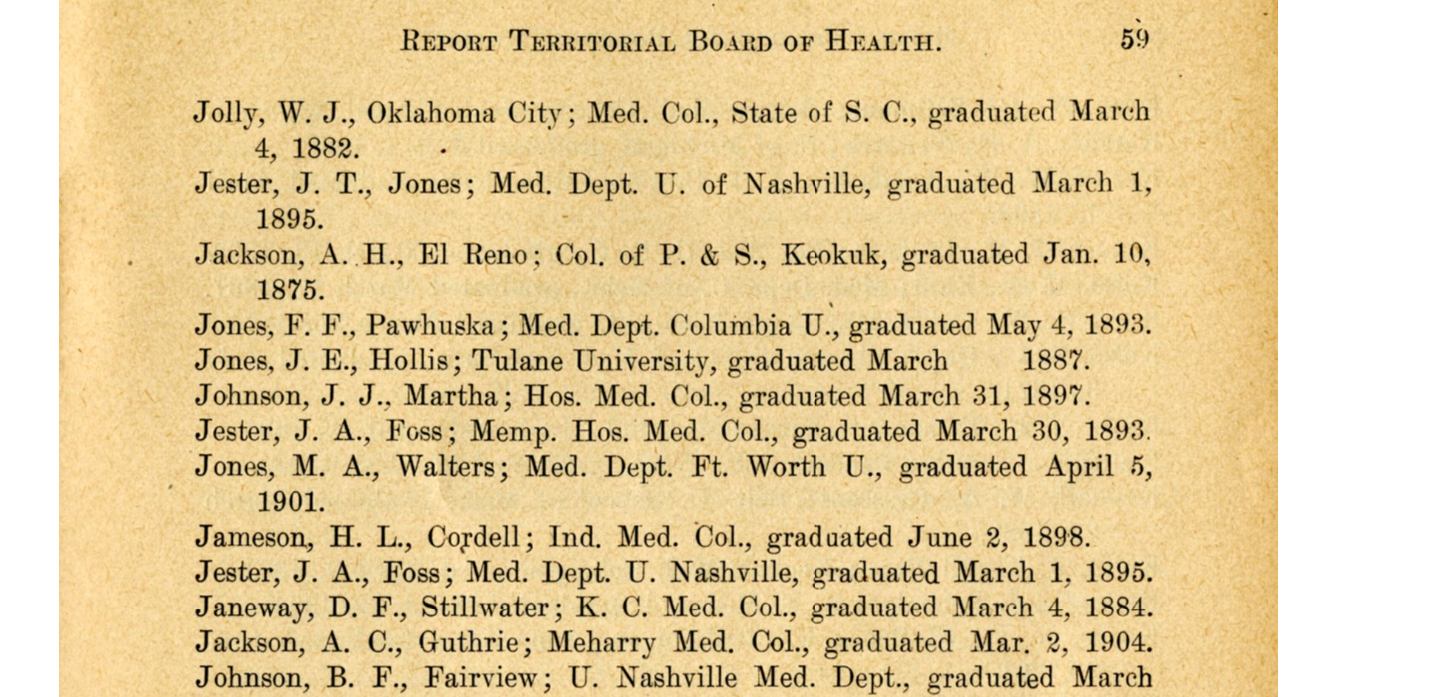
He earned his medical degree at Meharry Medical College in Nashville, one of only two historically Black medical schools in the country, founded in 1876 to train Black physicians at a time when most white medical schools refused them admission. In August 1903, he received his first medical license in Arkansas — issued by a tribal medical board, reflecting the Native-governed licensing authority that operated in Indian Territory before Oklahoma statehood in 1907. By the early 1900s, Dr. Jackson had relocated to Tulsa, Oklahoma, where the Greenwood district was rising into what Booker T. Washington would call “the Negro Wall Street of America.”
His work
A surgeon of national reputation
In Tulsa, Dr. Jackson practiced surgery and general medicine, serving both Greenwood's Black community and, quietly, when white doctors would not handle a case, white patients as well. He performed surgery at Frissell Memorial Hospital, a Black-owned-and-operated hospital that served the Greenwood district, and maintained a private office on the corridor of professional offices near Greenwood Avenue.
His skill was nationally recognized. Drs. William and Charles Mayo, co-founders of the Mayo Clinic in Rochester, Minnesota. are widely cited as describing him as “the most able Negro surgeon in America.” He participated actively in the National Medical Association (the professional society of Black physicians, formed in 1895 after the American Medical Association refused to admit Black doctors), appearing as a discussant on diagnostic medicine at NMA conferences, including the differential diagnosis of scarlet fever and diphtheria, then leading causes of childhood mortality.
The record
Greenwood in his lifetime

Booker T. Washington High School, Tulsa, the Greenwood institution that educated the children of Dr. Jackson's patients
Wikimedia Commons · public domain (c. 1921)

Greenwood, June 1, 1921, smoke rising over the district where Dr. Jackson had practiced surgery
Wikimedia Commons · public domain (American Red Cross, 1921)

The Woods Building on Greenwood Avenue after the massacre, one of the many buildings Dr. Jackson had served patients in
American Red Cross via Library of Congress · Wikimedia Commons · public domain
His context
Jim Crow in the Exam Room
Dr. Jackson practiced medicine inside a system engineered to exclude him. In the early 1900s, the American Medical Association refused to admit Black physicians. The vast majority of the country's medical schools — including Johns Hopkins, Harvard, and the University of Chicago — did not accept Black applicants. Of more than 150 medical schools operating in the United States at the time, only two trained Black doctors: Meharry Medical College in Nashville (founded 1876) and Howard University College of Medicine in Washington, D.C. (founded 1868). Both were built specifically to fill the void left by white institutions' refusal.
The 1910 Flexner Report, commissioned by the Carnegie Foundation, restructured American medical education — and, intentionally or not, shuttered most of the small, underfunded Black medical schools that had tried to fill the gap. Five of the seven remaining Black medical schools closed within a decade. Meharry and Howard survived. Dr. Jackson graduated from Meharry, one of a tiny national cohort of Black physicians trained under these conditions.
Beyond credentialing, the racial science of the era — phrenology, Social Darwinism, and the pseudoscientific claims of physicians like Samuel Cartwright (who invented fictional diseases to justify slavery) — produced a medical culture in which Black bodies were regarded as experimental subjects rather than patients deserving care. Black physicians navigated this by building their own parallel infrastructure: the National Medical Association (1895), the Journal of the National Medical Association, Freedmen's hospitals, and Greenwood's own Frissell Memorial Hospital, where Dr. Jackson performed surgery.
Anecdotal accounts collected by Greenwood survivors and their descendants describe Dr. Jackson as a physician who treated both Black and white patients — the latter in cases that white doctors refused or could not handle. His willingness to cross the color line in his practice, at personal risk, is part of the oral history preserved by Greenwood community institutions and cited in several secondary sources.
His scholarship
Published Work & Subject-Matter Expertise
Dr. Jackson was not only a practitioner — he was a contributor to the medical literature of his era. His documented contributions include participation as a discussant at the National Medical Association's annual conferences, where he engaged on the differential diagnosis of infectious disease at a time when scarlet fever and diphtheria were among the leading causes of childhood mortality in the United States.
The Journal of the National Medical Association (Vol. 10, No. 3, p. 142) records Dr. A. C. Jackson of Tulsa, Oklahoma as a discussant — a physician whose clinical opinions were considered peer-level contributions, not mere audience commentary. In this context, “discussant” carried academic weight equivalent to a conference presenter: your name was printed, your reasoning was preserved in the literature, and your expertise was cited by colleagues.
The Mayo Clinic founders' endorsement — describing him as “the most able Negro surgeon in America” — was not a compliment granted lightly. William and Charles Mayo were among the most influential figures in American surgery in the early 20th century. To be named by them, across racial lines, in an era when Black medical achievement was systematically suppressed and uncredited, is a primary-source measure of Dr. Jackson's clinical standing.
His death
June 1, 1921
At dawn on June 1, 1921, a white mob, including hundreds of civilians who had been deputized at the National Guard armory, crossed the railroad tracks into Greenwood. They burned 35 city blocks, killing an estimated 300 Black residents and leaving 10,000 homeless.
Dr. Jackson, 42 years old†, walked out of his home with his hands raised, surrendering to armed white men. A white landowner who had come to check on his property recognized him and called out to the men not to hurt the doctor.
They shot him anyway. Witness “Judge” Oliphant later testified that the killer was a young white man in a white shirt and cap, a “citizen,” not a law enforcement officer. The same witness also said that he saw police on the scene, and that the police were “the chief fellows setting fires.”
The men who shot Dr. Jackson looted and burned his home while he lay dying. Other looters in the neighborhood, in the DOJ's own words, “danced a jig and just had a rollicking easy good time.”
He died of his wounds. The historical record generally fixes his death on June 1, 1921, but his sister Minniemaintained that he survived a day or two longer before succumbing to his injuries. After his death, his captors paraded his body through the streets like a trophy.
No one was ever prosecuted. The federal Hate Crimes Prevention Act, had it existed in 1921, could have been used to prosecute the murder, the U.S. Department of Justice cited his case specifically in its January 2025 Review.
His burial
Five days on horseback to Guthrie
In the days after the massacre, the bodies of murdered Greenwood residents were dumped into the Arkansas River or buried in unmarked mass graves. Black-owned funeral homes that might have intervened were under direct threat, authorities warned operators that their buildings would be burned if they attempted to handle the dead with dignity.
T.D. Jackson refused that fate for his son. He recovered Dr. Jackson's body and rode by horseback for five days to a family burial plot in the Black section of a cemetery in Guthrie, Oklahoma, where he laid his son to rest beside earlier generations of the family.
The grave was lost to time. In 2010, the family relocated the burial site. In 2013, a headstone was finally placed. Dr. Jackson rests in close proximity to his mother and father.
The reason this exists
The Jackson family — keepers of the legacy
This platform was built by the Jackson family. After decades of their relative's story being buried or reduced to a footnote, the family made it their shared work to change that — to make sure the world knows who Dr. A. C. Jackson was: not just a historical name, but a man of extraordinary skill and character who was murdered on his own front lawn, with his hands in the air, in front of witnesses, and for whom no one was ever prosecuted.
The family is not simply preserving a memory. Together they are pushing Dr. Jackson's legacy forward — advocating for recognition of the injustice, demanding the accountability that 1921 never delivered, and building the infrastructure so that future generations of the Jackson family and the descendants of Greenwood can find each other, learn their history, and continue the work that was violently interrupted on June 1, 1921.
Every section of this platform exists because the Jackson family refused to let their relative's name be erased. The injustice happened. The record survives. The legacy continues.
His legacy
The work that continues
The A. C. Jackson Foundation carries Dr. Jackson's name into the present. The work he was doing on June 1, 1921, extending medical care to a community that the surrounding city refused to serve, training the next generation of Black physicians, and being publicly visible at a time when that visibility cost lives, is the same work this platform exists to continue.
Every section of Dr. AC Jackson Foundation is built in his memory:
- · The Jackson Family, the documented genealogy of Dr. Jackson — known family members, primary-source profiles, and a call for descendants to come forward.
- · Photo & Document Archive, every surviving photograph, newspaper clipping, professional record, and historical document in the collection.
- · Healthcare You're Owed, surfacing the federal, state, and hospital programs (including the 501(r) charity care every nonprofit hospital is required to offer) that most eligible Americans never claim.
- · Wealth & Legacy Academy, financial literacy, entrepreneurship, credit, and real estate, taught through the Greenwood blueprint.
- · Modern Black Wall Street, a directory of Black-owned businesses keeping dollars circulating inside the community.
- · Descendants of Greenwood, reconnecting the families scattered in 1921, including Dr. Jackson's own.
- · The Greenwood Portal, an immersive walkthrough anchored at Dr. Jackson's residence as checkpoint six.
Primary & secondary sources
- U.S. DOJ Civil Rights Division, Review and Evaluation: Tulsa Race Massacre (Jan. 2025), ¶¶ 274–276, 312–315, 2042–2044
- 1921 Tulsa Race Massacre Commission Final Report (2001)
- Journal of the National Medical Association, Vol. 10 No. 3, p. 142. Dr. A. C. Jackson of Tulsa, Okla, as discussant
- Tulsa Historical Society & Museum exhibit on the 1921 Massacre
- Greenwood Cultural Center archive
Some biographical details (medical school attendance, hospital affiliation) are drawn from secondary historical sources and the oral tradition preserved by Greenwood institutions. Before this page is used as an authoritative biographical reference, primary-source verification should be confirmed with the Greenwood Cultural Center and Meharry Medical College registrar.